Pelican and PurHome Saltless Conditioners

Kevin asked the following questions:

Mark,

I have been reading your replies on www.plbg.com and like the fact that you are so candid.  I am not a salesman for any company nor do I endorse any specific product brands.  I am a homeowner in Bellevue, NE with city water of 10 grains hardness.  I am tired of the scale om my tub, faucets, dishwasher etc.  I am not particularly fond of the slick feeling most water softeners create but would like to condition the water so it is easier on skin (I have sensitive skin and so do some of my kids), clean my pipes (the house is only 8 years old) and appliances, and water fixtures.  I have read about salt-free water conditioners such as PurHome and Pelican. I just read your comment today stating that Next Filtration is the only one that tested to 99.6% effectiveness rating.  After reading the literature on Pelican, Purhome and Next Filtration,  I find them all very similar in technology.  In fact,  the Next Filtration website literature data sheet looks almost identical to the data on the Pelican system and how they claim it works, yet you seem to think there system is unproven (and I would not disagree with you on that).  Do you know of any one that has the Next Filtration system that you have personally seen work or better yet, that would be willing to call me to talk to see how well it actually performs?  I only put so much stock in reviews I read on the web.  I am still very skeptical about salt-free systems and don’t like the idea of the maintenance associated with salt water softeners either.  Any suggestions?  It seems very hard to find an unbiased opinion on any specific system as everybody just wants to sell their product.

Thank you,

Kevin

The Water Doctor Replied:

Kevin,

Yes, everyone wants to sell their own products, and we are no different.  The major difference is that we don’t resort to lies to sell our product.  The biggest problem I have with Pelican is that they say their system “produces naturally soft water.”  NOT TRUE!  They also say that with their system you will use 40-60% soaps and detergents.  AGAIN, NOT TRUE!  When I read that kind of stuff I lose all confidence in a company.  nextScaleStop is not what they say it is (check THIS out).  I would be glad to talk with you.  Please call me at your convenience at 800-608-USWA.

Leave a Comment

Advanced Water Filters

Tony asked:

I live in California and will be moving to a new house next week. I’ve been reading a lot about saltless conditioners and is leaning towards buying a system from www.Advancedwaterfiltration.net.   They claim a 99.6% effectiveness against scaling which is my main reason for wanting a conditioner.

Are you aware of this company? I appreciate your response.

Also, if I purchase green wave 12 gpm system, what is the cost of the replacement media? And how often is it generally replaced?

The Water Doctor Replied:

  1. 99.6%?  Pretty good!   Why not 107.3%?  The only company who claims 99.6% effectiveness is nextScaleStop and they no longer use that media which as “allegedly” validated at 99.6% effectiveness by DVGW-512.  In fact, I believe they now use the same media we have been using.
  2. The advanced water filters site is very devoid of any information as to how it works.  Frankly, the lack of information on their site make me very suspicious of the product.  There is very little information.
  3. Check them our with the BBB as you would any company.
  4. The GreenWave media needs replaced very 4-6 years.  If it needs replaced in years 4 or 5, it will be $189.00.  After year 5, it would be $356.00.

Be careful!  Things that sound too good to be true, might be!

Leave a Comment

What Are The Advantages Of Pleated Filters?

The staff at US Water are frequently asked about what type of filters to use.  Today we are going to focus on whole-house filtration, specifically what type of filter is best for that application.

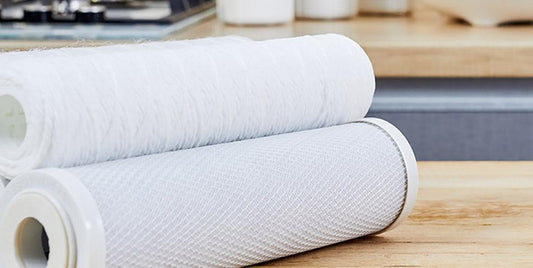
Pleated filter cartridges outperform wound, spun, melt blown, resin bonded and other ”depth” type filter elements because these cartridges are pleated to provide increased surface area and longer life.  Lower pressure drop is  another significant advantage of using pleated cartridges, which allows for increased flow rates and the use of smaller filter housings to reduce capital equipment costs.
Additional savings are provided because cartridges made with 100% synthetic filter media are cleanable, five micron and up, to lower cartridge replacement costs.  A good pleated filter cartridge will outperform other types of cartridges because the filter media is systematically produced using 100% synthetic fibers, with no binders or additives to leave a residue, foam or contaminate.  Pleated cartridges provide “depth” filtration for greater sediment removal, along with more surface area.
Pleated Filter Features
  • Filter media is pleated for greater surface area.
  • Synthetic filter media is cellulose-free.
  • Thicker filter media has a greater capacity to capture and retain particles, compared to thin, more rigid media types, which have less void space for particle retention.
Pleated Filter Benefits
  • Low pressure drop, long life, reduced filtration costs, compared to wound and spun cartridges.
  • No additives or binders, which may cause foaming.
  • Increased dirt holding capacity, longer life, fewer cartridge replacements needed, and reduced filtration costs, compared to other pleated cartridge suppliers.
  • Increased particle removal efficiency and longer life.
  • Reduced cost per gallon filtered.
It would be very unusual for there to be a situation where a pleated filter would not dramatically outperform any other filter for a whole house application.  Simply put, a pleated filter works better and costs less.  US Water distributes pleated filters manufactured by Harmsco, Watts, Flowmatic and Liquatec to fit most filter housings, such as American Plumber, Pentek, Ametek, Cuno and others.

Leave a Comment

Salt-Free Conditioners vs. Salt Water Softeners

Brenda asked:

“I have had salt based water softeners in the past and loved them. I now live in a multi-story townhouse, the water source to the unit is in the front, the HOA will not allow a water softener unit in the front. I considered the saltless system because it is smaller and I could possibly hide it, I ‘m still considering it. Another option is to put whatever I get in the garage with the tankless hot water units, meaning only my hot water will be soft. Will this be enough to do anything for my appliances or my skin?”

Answer:

Putting a water softener only on the hot water is kind of like putting one foot in ice water and the other in boiling water – on the average you won’t like the experience! In your case, I would recommend a saltfree water conditioner. While it may not rise to the level of a water softener (using salt), it will protect your appliances and the carbon filter in the Green Wave Cascade will reduce or remove the chemicals and chlorine which are skin irritants.

Here’s what I would recommend:
http://www.uswatersystems.com/shop/products/10-GPM-GreenWave-Cascade-No%252dSalt,-Non%252dElectric,-No-Waste,-Anti%252dScale-Water-Conditioner.html

Leave a Comment

Water Softeners Are “Green”

We get a lot of questions about salt-less water conditioners, and many times these questions are the result of people who want to be as “green” as possible, thinking that a water softener which discharges sodium chlorine into the environment simply cannot be green.  I beg to differ.  And while we do sell salt-free or salt-less water conditioners, I contend that a water softener is the “greenest” appliance in your home!

Think about it for a moment:  How much water does your dishwasher waste?  How much water does your washing machine waste?

Answer:  ALL OF IT!

A computerized meter-controlled (demand) water softener on 20 grain hard water will deliver about 1,200 gallons of water between regenerations, while only wasting about 40 gallons of water.  That’s about 97% efficient!  Out of 1,200 gallons, it only wastes 3%.  How much greener do you want to be?   Your dishwasher and washing machine are 0% efficient.

A major new study by the independent Battelle Institute revealed water softeners save significant amounts of money and energy in the home. Gas tank water heaters operated on softened water maintained the orginal factory efficiency rating over a 15-year lifetime. On the other hand, heaters operated on hard water lost as much as 48% efficieny. Each year an electric water heater would accumulate .4 lbs of scale per every 5 gpg when using hard water.   If you have 20 grain hard water, that’s 1.6 pounds of dissolved rock in your water heater a year.  No wonder it takes 3 men and a wild monkey to carry out an old water heater!
Now, there is one other big thing to think about –  Soft water (water softened by salt) enables you to save over 50% on all of the following:
  • Soaps
  • Detergents
  • Phosphates
  • Bleach
  • Chemical Water Softeners (like Calgon)
  • Chemical Lime Removal Agents
  • Shampoos
  • Conditioners

With 50% or more less chemicals going back into the environment with a “salt-based water softener,”  how can it not be called “green?”

Leave a Comment

Popping the Lid on Bottled Water

Every day many Americans pop the lid on a water bottle and consume the contents.  Ahhhhhhhhhhh!  Fresh, clean water.  Or is it?  Happily, the answer is YES – most bottled water is safe to drink.  Occasionally, there is a report that some bottled water company fails to meet the requirements, and may be unsafe in some manner, but that is the exception rather than the rule.  The bigger question is:  What is Bottled Water?  If you put sewage water in a bottle and install a cap, it’s “bottled water”, right?  Now, we are not even insinuating that bottled water is like that, but in some ways the rules are lax for bottled water.  While bottled water is a growing segment of the beverage market, there are still two basic types of bottled water.  Those being “Spring Water” and “High Purity Water.”  We will discuss the differences.

SPRING WATER – First of all, we need to realize that taste is subjective.  Pepsi or Coke?  Miller or Coors?  Coffee or tea?  You get the picture. The fact of the matter is that most spring water is really not from a spring, but from a well or may even be municipal water.  Spring water is typically water in which the minerals (calcium and magnesium) have not been removed.  Water quality can be measured in TDS (total dissolved solids) and spring water is typically from 150 to 450 ppm (parts per million which is also the same as mg/l – milligrams per liter) of TDS.

Isn’t the calcium and magnesium good for you?  Sure, but consider this:  WATER IS NOT A SIGNIFICANT SOURCE OF MINERALS.  We believe that you simply don’t drink enough water with minerals to have a significant impact on your health. We advise drinking water that you like, whether it be spring water or high purity, because if you like it, you will obviously drink more and more is better.

It’s a fact that 35,000 chemicals have been invented since World War II and some of these chemicals end up in our water supplies.  Things like MTBE, TCE, PCB, THM, Atrazine, chlorine, antibiotics and other pesticides can be in the water supplies.  This is what makes filtering you water so desirable.  Not only does it taste better, but it’s also better for you.

HIGH PURITY WATER – This is typically water which has been purified by one of the following processes:  (1) de-ionization; (2) distillation; or (3) reverse osmosis.  It is the opinion of most people who do blind taste tests that deionized and distilled water tastes flat and even bitter.  While slightly (and we do mean ever so slightly) better in purity, reverse osmosis water is typically high in dissolved oxygen which makes water palatable.  The number one selling brand of bottled water in the USA is Aquafina, which is reverse osmosis (RO) water.  The number two selling brand is Dasani, which is also RO water, with a few minerals added back in.

So, which bottled water should you drink?  Well, it’s a matter of taste, but our advice is that you shouldn’t drink bottled water unless you have no other choice.  WHAT?  Why is that, you may ask?  Consider this:

  • Each year more than 10 billion plastic water bottles end up as garbage in landfills.  As the US population increases, the demands on our water resources continue to increase. This puts a huge strain on our environment, but happily there is a way to make a difference and impact this growing trend.
  • Purchasing a home water filtration system or reverse osmosis system can lead to reduced plastic water bottle waste. Instead, make your own water and place it in a reusable bottle. Your average water filter can replace up to 3,000 16oz plastic water bottles saving you money and saving the environment. You are saving a considerable amount of money by filtering your own water and you are saving the environment by eliminating plastic water bottles from the landfill.

What kind of filtration system should you get?  Do the taste test:  Do you like Spring Water (water with minerals)?  Then purchase a home filtration system such as THIS.  If you like Aquafina, then purchase a home reverse osmosis system such as THIS.   The water you drink will make a difference in your health and can make just as much of a  difference in the environment!

Leave a Comment

Removing Sulfur Odor From Water

Mike wrote:

We drilled a new well that has both coliform bacteria and high levels of hydrogen sulfide. I have been looking to install a chlorine feeding pump, retention tank and carbon filter. We have used this system in the past at our old house with mixed results. The hydrogen peroxide system looks interesting. Will this system also kill the coliform bacteria and any other bacteria that may be in the water?

US Water Response:

Chlorine is a better sanitizer, in that it kills bacteria better, but hydrogen sulfide needs to be oxidized to be removed and chlorine is not a good oxidizer for high levels of hydrogen sulfide.  To remove hydrogen sulfide, you would want to use either a FILOX or OXi-GEN system.  In many cases, higher levels of hydrogen sulfide (also call hydrogen sulphide) can be removed with a Filox system, which requires no chemicals, just backwashing.  In extreme cases, chlorine has to be injected during the backwash cycle to help clean the media. 

Hydrogen Peroxide (H2O2) is a dramatically better oxidizer, which is what you need to eradicate sulfur.   Most likely, if you have high sulfur and bacteria, the chlorine might kill the bacteria, but it won’t get rid of all the sulfur.  Hydrogen peroxide ALWAYS gets rid of ALL the sulfur and there are no carcinogenic disinfection byproducts with H2O2, like with chlorine (THM’s). 

So, what to do about the bacteria?  You can use the Filox or peroxide system for the sulfur, and follow with an ultraviolet light after the Filox or Oxi system, and softener, if you have one.  UV is a much better sanitizer than chlorine, and kills bacteria as well as cysts.

Leave a Comment

Do Salt Free Systems Really Work?

Tracie asked:

Just curious as to why you seem to not like or you are not completely convinced that the Salt Free systems really work, yet you sell them. So, is yours the only one out there that really works or are you selling a product that I’ll be 50% satisfied in? I don’t necessarily need super soft, slimmy water, but water that is not causing corrosion in my pipes and on my dishes. I’m also not sure that Salt softners arent for me. We used one a few years ago and it killed my plants. So, if it killed my plants, is it harmful to us and pets?”

US WATER Response

You have raised several valid points and we will attempt to answer them one-by-one:

  • We are completely convinced that salt-free systems work.  We just want everyone to understand that salt-free water conditioners are not “water softeners” and that they do not soften the water.  They do an excellent job of preventing scale and our GreenWave Cascade system removes the harmful contaminants while leaving the beneficial minerals.  It’s just that we do not want to give the impression that they produce soft water, because they do not.  One of our competitors even says this:  The Pelican Natursoft keeps the healthy minerals in the water so you can enjoy naturally softened water.” How can we say in a politically correct way that the previous statement is simply not true?  We don’t believe in lying to sell our products.  We will always tell you the truth, and the truth is the salt-free or salt-less systems are not softeners, but many people do not like the slick feel of soft water.
  • Is ours the only one that works?  Probably not, but we have been building and testing salt-free conditioners for several years and our MEP Technology is second to none.  It really works!
  • Salt based water softeners add sodium to the water, and although it is not a significant amount, daily watering of plants will build up sodium deposits around the root structures and damage, or even kill the plant.  If you have a water softener, you should not use softened water to water your plants.  PERIOD!  In reality, hard water is not the best either, especially municipal water which contains chlorine and other chemicals, which can also damage plants.  Reverse Osmosis (RO) water which has all the total dissolved solids (TDS), chlorine and chemicals removed will help your plants flourish.  It’s also great for your dog… and humans too!

Leave a Comment

DVGW-512 – Urban Legand?

More and more people are wondering if it really exists?   DVGW-512 is allegedly the standard for testing salt-free water treatment systems.  In fact, one company (WATTS) is claiming (in a convoluted, round-about way) that their product is approved by DVGW-512.  Check out this LINK if you want proof.  While they don’t actually “LIE” they lead you to believe that their product is 99.6%  effective (as stated in the test).

There are a couple of issues here, not the least of which is that the testing was done on the ORIGINAL MEDIA, but they are no longer producing the original media (from nextScaleStop).  They claim it is better.  I remain unconvinced.  In fact, we have had more failures of their new media than their older media (and we had plenty of failures of that media as well).

Let’s not beat around the bush, the media in Watts One Flow is nextScaleStop media – they are one and the same!

Pelican uses the DVGW-512 standard in their website, but it turns out it is “Third Party-Tested.”  What does that mean?  It could mean that they gave someone some money to test it and they said it was great.  But what do you expect from a company who says that their system delivers “naturally softened water,“  which is totally false!  Naturally softened water?  Where did they get that?  Look it up!   According to one of the leading water experts in the country:

Naturally soft water supplies have a paucity of any dissolved minerals, or an absence of total dissolved solids (TDS), an excess of carbon dioxide over alkalinity, and generally, a low pH.

Does Pelican do that?  Hardly!  When they start with something that is not true, how much can you believe?  However, I digress.  Here’s the deal:  I think the population can be divided into three thirds:

  1. People who won’t believe anything.  You could tell them that the sun will rise tomorrow and they would doubt you;
  2. People who will believe everything.  I can tell them I am Elvis and they will believe it (this is the “lunatic fringe.”); and
  3. People who are “open” or receptive to new and better things, if they work.

Salt-free systems are sold to to people in groups #2 and #3, which means that 50% of the customers are automatically satisfied because they will believe anything you tell them (they have been on the spaceship and have seen the little green men).   These people frequently write glowing testimonials about how wonderful a product is, but if you visited their residence, you might be shocked.

What about the other third – the ones who are receptive, but not in the lunatic fringe?   These are rational people who often want to be “green” or do not like carrying salt for their water softeners, but make no mistake, they are not any one’s fool!  I have no hard evidence, but from what I have seen,  about half of these people are happy with the salt-free water treatment systems.  50%!  That’s a pretty low satisfaction rating.

Bear with me.  Do the math.  50% of the people who buy salt-free systems to are in the lunatic fringe (100% customer satosfaction)  and 50% are receptive (50% customer satisfaction), which means that 25% of the customers have to be refunded.  What these companies do, is build in the returns into the price and sell them all day long, knowing that they will have to refund 25%, but the other 75% brings them big profits.

Fundamentally, I have a problem with pleasing the customer 75% of the time – that’s too low!

Is there validity to salt free systems using nextScaleStop and Filtersorb SP3?  Yes and since nextScaleStop has changed their formula, I believe that Filtersorb and nextScaleStop are  now nearly identical in performance.  Ask Watts.  They use both Next and Filtersorb. I will be the first to say that I believe they are equal in performance.

Pelican?  I have no clue what they use and they aren’t telling anyone.  That worries me…

Leave a Comment

Angie’s List Super Service Award

Every year, Angie’s List chooses their “Super Service Award Winners” for companies which have achieved and maintained a superior service rating. Less than 5% of the companies listed on Angie’s List achieved this rating (by the way, if you aren’t a member of Angie’s List, you should check it out HERE.

US Water is pleased to announce that they have been selected as a winner of the Angies’ List Super Service Award for 2009.  US Water also has a spotless record with the Better Business Bureau.  As a family-owned company, we are proud of our record of service.  We would like to thank you if you are already one of our customers, and if you are not, “What are you waiting for?”

Leave a Comment